Insights

Something strange has been happening in the world of business and human rights. Leaders of multinational corporations around the globe are speaking out about the negative human rights challenges faced in their operations and supply chains. Where most companies seek to avoid any public association with human rights issues, these business leaders are breaking the mold – and they want others to do the same.
icon-content-article-grey
“We live in a world where it is easier to imagine the end of humanity than it is to imagine the end of capitalism,” said Fredric Jameson about 40 years ago when Climate Change wasn’t even on the agenda (Capitalist realism, 2010). What is worrying is that this claim holds true to this day. When did we move from politics of collective well-being to politics of consumption?
icon-content-article-grey
Business Call to Action to launch new Inclusive Business Management Practices Tool to guide multinational companies to scale their inclusive business initiatives 
icon-content-article-grey
I’ve often considered being the odd one out as something of a badge of honour, particularly in a business context. Any aspiring intrapreneur needs to be comfortable with breaking free from the herd, even if others think you’re a little bit crazy.
icon-content-article-grey
Financial access and inclusion continue to be sold to farming communities in the world’s leading supply chains at the very price of poverty. How do we reduce this toxic trade-off, why is it taking so long and how does it impact the planet’s future? Tasneem Mayet, BFP Ambassador, shares insights from conversations had at #BFPOXFORD, closing with some examples of what has worked well in the industry and yet why it is not enough.​
icon-content-article-grey
The global coffee price crisis has drawn headlines around the world. But rather than view it as an isolated phenomenon, we must view at as part of a larger set of challenges affecting coffee farmers. To truly change the outlook for the world’s 12 million coffee-farming families, we must address these longstanding issues.
icon-content-article-grey
On International Day for the Eradication of Poverty, global businesses collaborate to launch a new toolkit, Reducing Poverty through Employment. Members of the Global Impact Sourcing Coalition (GISC) share best practices for how to employ, empower, and improve the advancement prospects of those living in poverty, as a part of their direct and indirect workforces.​
icon-content-article-grey
The scale and complexity of the challenges ahead of us require a new ambition for how we collaborate across traditional divides. At Business Fights Poverty NYC 2019, we brought together experts and practitioners from business and the international development community for a roundtable discussion about how we can partner more effectively to deliver the Sustainable Development Goals (SDGs).
icon-content-article-grey
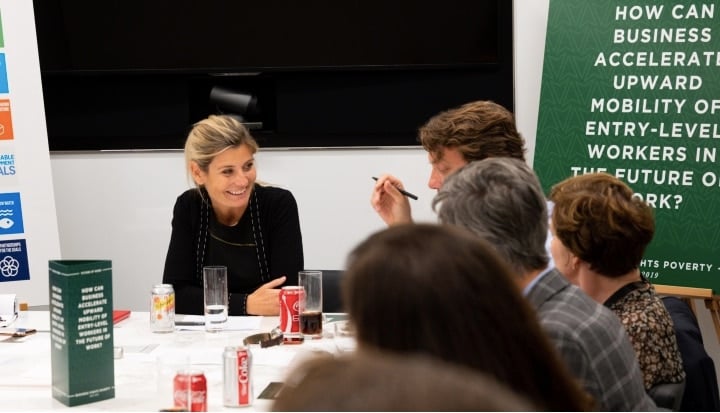
Business Fights Poverty is partnering with Walmart on a recently-launched Challenge which asks how business can accelerate the upward mobility of entry-level workers in the future of work. ​
icon-content-article-grey
Business Fights Poverty is partnering with the UK Department for International Development (DFID) on a recently-launched Challenge which asks what more can international donors do to increase business’ contribution to the SDGs?
icon-content-article-grey
On the International Day for the Eradication of Poverty, we remember the life and impact of Paul Polak, Market-Based Development Pioneer, who sadly passed away on 12 October.
icon-content-article-grey
As part of our Challenge on Purpose supported by GSK, VISA and Unilever, Business Fights Poverty convened a meeting of around 30 representatives from companies, financial institutions, NGOs and development institutions to discuss this pertinent topic.
icon-content-article-grey
During Business Fights Poverty NYC, expert insights were shared contributing towards a Challenge to find out how business can take an ecosystems approach to support Micro, Small and Medium Enterprises (MSMEs) in their extended value chains.
icon-content-article-grey
Business Fights Poverty is running a Challenge on the use of technology to tackle modern slavery in global supply chains, in partnership with Nestle and WBCSD. Technology has huge potential to challenge systemic opacity, and can disrupt systems where there is misinformation.
icon-content-article-grey
To mark the launch of a new Challenge supported by Walmart on the Future of Work, Enrique Ostalé, Regional CEO of UK, Latin America and Africa at Walmart International, and Zahid Torres-Rahman, Founder and CEO of Business Fights Poverty joined Brad Staples, CEO of APCO at Concordia’s 2019 Annual Summit, to speak about International Future of Work Trends.
icon-content-article-grey
The Business Fights Poverty lunch in NYC provided an opportunity to explore how companies can address gender equality challenges through their business aware practices. The discussion was focussed on the question ‘Why is SDG 5* for gender equality reportedly off-track and what can companies do differently to accelerate progress’?
icon-content-article-grey
Gender equality in the workplace is an important step in the creation of thriving societies and economies. However, the World Economic Forum’s Global Gender Gap Report 2018 suggests that at the current rate of change, it will take 202 years to achieve economic gender parity globally.
icon-content-article-grey
On a warm Friday morning in Nairobi, Shadrack Nzelu receives a job request through an app on his mobile phone. A client needs some electrical repairs. The day is already looking up, as this is his second job request of the morning. In the two years since he moved to Kenya’s capital for work, Nzelu has transitioned from a casual worker on construction sites to an online “gig” worker receiving a steady stream of requests through Lynk, an online gig platform.
icon-content-article-grey
Over the past 15 years, corporate leaders, investors, and nongovernmental organizations (NGOs) have demonstrated that, with the use of innovative business models, profit can be aligned with social and environmental progress. A departure from the “band-aid” corporate social responsibility (CSR) approaches of the 1990s, these strategies involve fundamental changes to business practices, including alterations to core products and services.
icon-content-article-grey
As world leaders and activists gathered in New York last month to address the climate crisis and the faltering rate of progress toward the UN’s Sustainable Development Goals (SDGs), the calls for systemic change are getting ever louder. Systems change is an inspiring goal – but how can we achieve it?
icon-content-article-grey

What do we mean by "Insights"?

Sub-topics within this category

There are no sub-topics within this Category.