Over the past year, the UK Department for International Development, through the Inclusive Business Boost programme, has supported the development of knowledge products to help multinational corporations (MNCs) scale and replicate inclusive business initiatives. We are pleased to be sharing the full suite of resources with you here.
“Enfin!” French CEO’s might smile at the new Statement of the Purpose of the Corporation signed by 181 American CEOs. To them, the idea that a corporation must serve the interests of all stakeholders is part of “savoir vivre” in business. It is therefore perhaps not surprising that France is leading on Corporate Impact Venturing, the practice of investing in startups with a positive social impact.
Join us for a live written discussion with a panel of experts to discuss how corporates can use technology to make a deeper and more responsible contribution to inclusive business. Live panel taking place on Tuesday 19 November, 10-11am New York (3pm-4pm London)
Business Call to Action to launch new Inclusive Business Management Practices Tool to guide multinational companies to scale their inclusive business initiatives
The potential for multinational companies to tackle global issues such as poverty, climate change and gender inequality is immense. With their reach, they have the ability to transform low income markets through innovative business approaches and help lift millions – even billions – out of poverty. Inclusive business is one such model, but numerous internal barriers are preventing multinationals from adopting or scaling this approach.
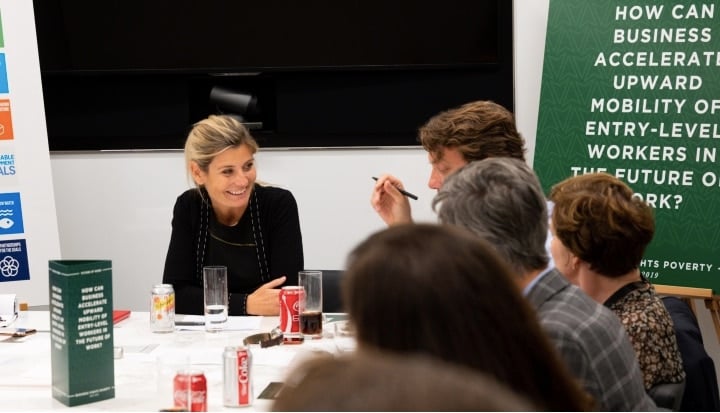
Business Fights Poverty is partnering with Walmart on a recently-launched Challenge which asks how business can accelerate the upward mobility of entry-level workers in the future of work.
On the International Day for the Eradication of Poverty, we remember the life and impact of Paul Polak, Market-Based Development Pioneer, who sadly passed away on 12 October.
During Business Fights Poverty NYC, expert insights were shared contributing towards a Challenge to find out how business can take an ecosystems approach to support Micro, Small and Medium Enterprises (MSMEs) in their extended value chains.
“If I have seen further, it is by standing on the shoulders of giants,” said Sir Isaac Newton in 1675. Over three centuries later, his recognition that nothing great is achieved in isolation is more relevant than ever. Would Steve Jobs have been able to transform his ideas into reality without a team around him? What relevance would Google have had without those who invented the internet?
Join us for a live written discussion with a panel of experts to explore how we can tailor management practices to help foster inclusive business. This discussion will take place on 25 SEP 15:00 – 16:00 BST / 10:00 – 11:00 EDT
MSMEs are vital drivers of growth for large companies and the lifeblood of communities, but many continue to struggle with multiple challenges. All those organisations with a stake in their success – large companies, governments, donors and funders, and NGOs – need to move towards a more holistic and joined-up approach to enterprise support with the goal of strengthening the underlying ecosystem in which MSMEs operate.
What happens when a bank makes a move towards achieving greater gender parity internally, combined with a razor sharp focus on the ambitions set out in SDG 5? Learn more in a conversation with Laura Hemrika, Global Head, Corporate Citizenship & Foundations and Patsy Doerr, Global Head of Diversity and Inclusion, Credit Suisse.
Impact champions such as India’s Empower Pragati are turning the impact measurement field around. Rather than defining impact based on past activities, they are using ongoing business activities to guide how they chart the course for the future
Having access to clean toilets is not just a basic human right – it’s also a health necessity. But in India, nearly 50 million people[1] lack access to adequate sanitation, increasing the risk of water contamination and diseases for these individuals.
Corporates venturing into low-income markets should ask themselves: could we buy one or several inclusive businesses to achieve our objectives? Our latest study reviews when investing instead of building makes sense, how to set up such investments and who can help.
We’re facing unprecedented times – a climate and environment emergency has been declared, displacement is a threat for more and more communities, civil space is increasingly restrictive, regressive girls’ and women’s rights, etc. – the need for everyone, brands included, to take action, has never been so urgent