Article
Environmental Justice and Multidimensional Poverty: Intersectoral Climate Action
2025-11-28 · By Flávia Alvim, and Laura Schneider, Social Inclusion Hub at Fundação Dom Cabral
This article explores how climate change deepens multidimensional poverty and why environmental justice must be central to policy and business. It calls for joint, intersectoral solutions to tackle overlapping vulnerabilities and highlights the role of the private sector in driving social and environmental resilience.
Environmental Justice and Multidimensional Poverty: the need for intersectoral and joint alternatives in the climate crisis context
The worsening climate crisis in recent years has brought unprecedented challenges to society. Extreme events such as floods, prolonged droughts, hurricanes, and fires are not isolated phenomena; they directly affect daily life by raising food prices, increasing respiratory diseases, and threatening safety. Although these impacts are global, they are not felt equally. Climate change deepens existing social inequalities, revealing the need for responses that integrate environmental, social, and economic dimensions. This discussion is particularly relevant as COP30 takes place in Brazil, in the heart of the Amazon – a region that experiences these transformations daily.
In this context, the concept of environmental justice becomes central. Originating in the United States in the 1980s, it highlights the disproportionate burden of environmental impacts on socially vulnerable groups. More recently, the idea has evolved to include recognition, meaning that achieving environmental justice requires understanding how current injustices were constructed, incorporating cultural, social, political, and economic factors. It is not enough to analyse the distribution of impacts; participation and empowerment of affected groups are essential. This perspective reinforces that addressing the climate crisis demands intersectoral, collaborative strategies that integrate diverse knowledge and vulnerability dimensions. Here, the link between environmental justice and multidimensional poverty becomes crucial.
Multidimensional poverty expands the concept beyond income, encompassing deprivations in housing, health, education, and employment. This approach enables a more precise identification of vulnerable populations and their needs, fostering more effective responses. The Oxford Poverty and Human Development Initiative (OPHI) has advanced this concept through the Multidimensional Poverty Index (MPI), based on the Alkire-Foster method. The MPI measures not only the incidence but also the intensity of poverty across dimensions.
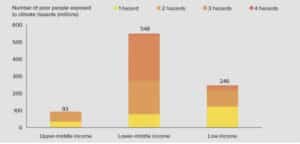
In its latest report (2025), OPHI analysed for the first time the relationship between multidimensional poverty and four climate hazards: high temperatures, droughts, floods, and air pollution. Findings show that lower-middle-income countries concentrate the largest number of multidimensionally poor people and the greatest exposure to climate risks. In these countries, 88% of the poor population faces two or more risks, totalling about 470 million people. This reality forms a “hidden epicentre” of multidimensional poverty, underscoring the urgency of policies that address overlapping vulnerabilities. For COP30, this debate is critical, as the principle of common but differentiated responsibilities requires acknowledging the distinct roles and challenges of Northern and Southern countries.
Graph Number of people (in millions) exposed to climate risks.
OPHI projections indicate that under high-emission scenarios by 2099, the poorest countries will endure 92 additional days of extreme heat, compared to 62 days in less poor nations. This shows that these countries bear today the double burden of poverty and environmental exposure and will be most affected in the future. The phrase “we are all in the same storm, but not in the same boat” aptly summarises this inequality. The intersection of poverty and the climate crisis calls for joint solutions that build resilience and promote a balanced future.
Although global in nature, solutions must start locally – within neighbourhoods, cities, states – and involve the private sector. Companies influence consumption patterns, create jobs, and shape production practices that can either exacerbate or mitigate social and environmental impacts. By adopting sustainable and socially responsible models, businesses can drive meaningful change.
Innovative initiatives are emerging worldwide. At Fundação Dom Cabral (FDC), in partnership with Wise Responder, the Business Multidimensional Poverty Index was applied for the first time in a Brazilian company, identifying vulnerabilities not only among employees but also their families. This positions the private sector at the centre of poverty reduction and climate justice discussions, demonstrating that sustainable development goes beyond numbers: it requires integrating economic performance with social and environmental responsibility.
Businesses do not operate in isolation; they depend on people and environmental balance to thrive. By safeguarding these pillars, they create value that transcends borders – strengthening regions, empowering communities, and building a fairer, more resilient future. COP30, held in the Amazon, reinforces the importance of knowledge and collaboration hubs, which unite academia, business, and civil society to design integrated solutions. These spaces are essential to address multidimensional poverty and environmental justice together, ensuring that no one is left behind in the transition to a sustainable world.
This article is part of the Business Fights Poverty Climate Series with Fundação Dom Cabral (FDC) taking place during COP30 Climate Summit in Belém, Brazil.