Article
Climate Change, Care, and Women-Led Businesses: The Missing Link in Climate Resilience
2026-09-18 · By Martha Melesse (Senior Program Specialist, International Development Research Centre), Kate Grantham (Associate, Kore Global), and Ella Duffy (Private Sector Development Specialist, Donor Committee for Enterprise Development)
Climate change is intensifying unpaid care burdens while creating new risks for women-led businesses. Drawing on research from DCED and Kore Global, this article explores how climate and care pressures intersect, why care enterprises are vital to community resilience, and how finance, policy and business support can strengthen women-led enterprises and climate-resilient economies.
On the islands of eastern Indonesia, climate change is creating a difficult balancing act for Komodo Water, a social enterprise that provides clean water to remote communities. Heavy rains can wash away mountain pipelines, storms make inter-island transport unsafe, and flooded roads can cut off entire communities. At the same time, climate shocks drive unpredictable swings in demand. During rainy periods, families harvest rainwater and water sales decline. During droughts, demand surges.
But the impact extends beyond the business itself. In the communities Komodo Water serves, collecting water is traditionally women’s responsibility. When water systems fail, women shoulder the burden, often spending hours each day fetching water for their families. By reducing water collection times from as much as six hours a day to just ten minutes, the enterprise is not only providing a vital service. It is also reducing unpaid care work and strengthening community resilience.
This story illustrates an often-overlooked reality: climate change, care work, and business performance are deeply interconnected. Yet these connections are rarely reflected in climate adaptation policies, programmes, and strategies.
A recent study commissioned by the Women’s Economic Empowerment Working Group of the Donor Committee for Enterprise Development (DCED) and conducted by Kore Global explored this intersection through a care lens. The findings reveal not only a significant risk to women-led enterprises, but also an important opportunity for businesses, investors, donors, and policymakers seeking more effective climate solutions.
The Hidden Impact of Climate Change on Women-Led Businesses
Climate change increases care demands while weakening the systems that support care provision. Droughts, floods, heatwaves, and extreme weather events can disrupt essential services, increase illness, and make it harder for households to access water, food, and fuel.
The result is a growing burden of unpaid care work, which continues to fall disproportionately on women and girls.
While the implications for households are increasingly recognised, less attention has been paid to what this means for women-led businesses. The study sought to fill this gap by examining how climate shocks influence women’s enterprise operations, livelihoods, working conditions, and resilience.
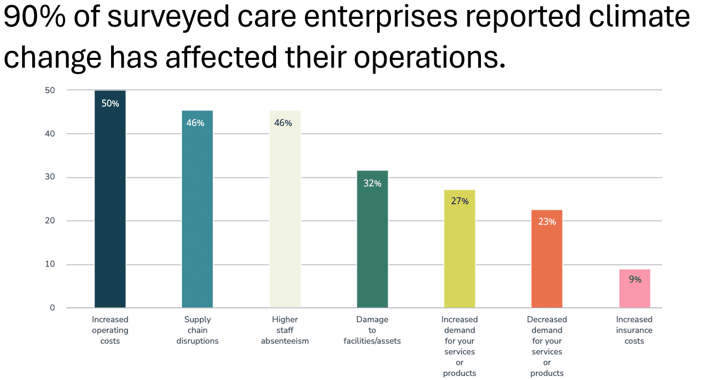
The findings show that climate and care pressures reinforce one another. As care demands rise during climate shocks, women entrepreneurs and workers often reduce their working hours, shift into more precarious forms of employment, or temporarily leave economic activity altogether. At the same time, businesses face higher operating costs, supply chain disruptions, workforce absenteeism, and declining productivity.
Perhaps most strikingly, 90 per cent of surveyed enterprises reported that climate change had already affected their operations. For many women-led businesses, these are not future risks. They are today’s business realities.
Care Enterprises: Vulnerable Yet Essential
One of the study’s most important insights is the unique role played by care enterprises.
Like many women-led businesses, they face significant challenges, including rising costs, staffing constraints, infrastructure disruptions, and limited access to finance. Yet they also provide products and services that help households and communities cope with climate shocks.
The research identified enterprises delivering childcare services, clean cooking technologies, water solutions, and renewable energy products that both reduce care burdens and strengthen resilience. In some cases, climate shocks increased demand for these services, highlighting their growing importance in a changing climate.
This creates a paradox. As climate pressures intensify, the need for care-related services grows. Yet the enterprises providing those services are themselves under increasing strain.
Supporting these businesses is therefore not simply a question of gender equality. It is a strategic investment in climate resilience and inclusive economic growth.
From Business Adaptation to Systemic Support
The encouraging news is that many women entrepreneurs are already adapting. Businesses reported diversifying suppliers, adjusting work schedules, strengthening emergency preparedness, investing in workforce training, and participating in community networks that share climate information.
However, adaptation cannot depend solely on the ingenuity and determination of entrepreneurs. Nearly three-quarters of surveyed care enterprises had implemented at least one adaptation measure, yet almost two-thirds still felt only slightly prepared, or not prepared at all, for future climate shocks.
The lesson is clear: women-led enterprises and care businesses cannot be expected to absorb growing climate and care pressures on their own.
For business leaders, investors, donors, and policymakers, this means recognizing care as both an economic issue and a climate issue. It means expanding access to climate-responsive finance, technical assistance, and adaptation support for women-led businesses. It also means investing in care infrastructure and services that enable women, workers, and enterprises to thrive.
As climate risks intensify, investing in the care economy may be one of the most overlooked opportunities for building resilient communities and economies. The experience of enterprises like Komodo Water reminds us that care is not a peripheral concern. It is a foundation of resilience. And as the climate crisis accelerates, ignoring it is a risk that businesses and societies can no longer afford to take.