Article
Together for 2026: Navigating a Shifting Social Impact Landscape
2026-01-30 · By Katie Hyson, Director, Thought Leadership
As social impact becomes more complex, politicised and contested, businesses and practitioners are rethinking how change is led and communicated. Drawing on insights from Business Fights Poverty’s Together for 2026 forum, this article explores how organisations can move beyond acronyms, build trust locally, integrate impact into core decision-making, and sustain leadership resilience in an uncertain global landscape.
At the start of the year, the Business Fights Poverty community came together for Together for 2026, an online forum designed to take stock of the year ahead and explore how businesses, civil society and practitioners can navigate an increasingly complex and contested social impact landscape. Held on 28 January, the forum created a timely space for reflection, honesty and collective problem‑solving, grounded in the lived experience of those working at the sharp end of social and environmental change.
The discussion was framed by three deceptively simple questions: what are the biggest challenges and opportunities for driving meaningful social impact in 2026; how can organisations communicate social impact when terms like ESG and DEI are increasingly politicised; and what does it take to lead change while protecting the personal resilience of those doing the work?
From uncertainty to opportunity
A recurring theme across the conversation was the sense of strain many organisations are facing. Participants spoke candidly about budget pressures, geopolitical uncertainty, regulatory whiplash, and growing fatigue among sustainability and social impact teams. Several contributors highlighted the risk of social impact being reduced to compliance and reporting, rather than sustained, long‑term change.
Alongside this, breakout discussions surfaced a deeper tension beneath the headlines: questions of localisation, legitimacy and power. Participants reflected on how organisations are increasingly judged not by where they are headquartered or what they commit to publicly, but by whether communities experience tangible improvements in their lives. In this context, social impact is becoming inseparable from local trust, stability and perceived fairness, with popular licence to operate emerging as both a risk factor and an opportunity.
Yet, alongside this realism, there was a strong sense that the current moment also offers opportunity. Many participants argued that today’s challenges are clarifying what truly matters. The era of grand commitments and polished narratives is giving way to something more grounded: specific actions, honest communication and a renewed focus on outcomes rather than labels. As several contributors noted, when organisations talk clearly about risk management, resilience, talent, productivity, or trust, they are often describing social impact without relying on contested terminology.
Communicating beyond the acronyms
The politicisation of ESG and DEI featured prominently in the discussion, particularly the growing phenomenon of “greenhushing”: organisations doing meaningful work but choosing not to talk about it for fear of backlash. Contributors shared practical advice for navigating this tension: focus on the work rather than the acronym; be transparent about trade‑offs; communicate progress in chapters rather than sweeping statements; and ground stories in data and lived experience.
Breakout conversations added an important layer to this. Participants emphasised that reframing language is no longer sufficient on its own. In a climate of scepticism and fatigue, credibility comes from delivery. Visible action, consistency over time and openness about what is hard or incomplete were seen as far more persuasive than confident narratives or ambitious pledges.
Several participants also noted that social impact is most resilient when it is embedded into decisions that already matter to the business. Rather than advocating for impact as a separate agenda, progress is underway to integrate social considerations into existing frameworks such as risk management, supply chain resilience, workforce strategy, capital allocation, and emerging areas like AI governance. In these cases, impact is not competing for attention but strengthening core decision‑making.
Leading change without burning out
The third strand of the conversation focused on leadership and resilience. Many participants acknowledged the emotional toll of driving social impact amid uncertainty, shrinking teams and rising expectations. Advice shared ranged from building systems rather than relying on individual champions, to investing in peer‑to‑peer learning and mentoring, and recognising that rest and reflection are not luxuries but strategies for sustained impact.
Breakout sessions brought a more candid tone to this theme. Burnout was widely recognised not as an individual failure, but as a system issue. Participants described the strain of waking up to headlines that threaten years of work, and the exhaustion of constantly having to justify the value of social impact. There was a strong call for leaders to take responsibility for pace, priorities and organisational design, creating cultures where people can pause, reflect and stay connected without losing momentum.
Collaboration also emerged as both a source of pressure and a source of resilience. With funding shrinking across sectors, organisations are increasingly being pushed into deeper partnerships. While this can mean letting go of control, attribution or familiar ways of working, many participants saw collaboration under constraint as essential for scale, learning and long‑term viability.
With thanks to our speakers and community
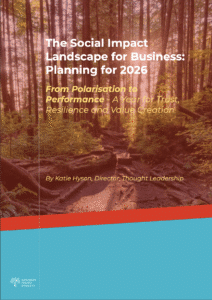
The forum opened with insights from Rachel Cowburn‑Walden, Strategic Business and Human Rights Adviser, and Meshack Kawinzi, Social Sustainability and Gender Equality Specialist, whose reflections set the tone for an honest and practical discussion. We also thank Katie Hyson, Director of Thought Leadership at Business Fights Poverty, who shared findings from recent one‑to‑one interviews with corporates and NGOs, drawing on the Social Impact Landscape for Business paper that framed the conversation.
We are grateful to our named contributors, Paul Ellingstad, Stef Engels, Peter Hall, Ilze Melngailis, Maya Middlemiss, Jennifer Owens, Maggie Rarieya, Hamish Taylor, and Beatriz Tumoine, for sharing their perspectives so generously in the Forum.
Above all, thank you to the wider Business Fights Poverty community, whose questions, reflections and lived experience shaped and enriched the discussion. You can read further insights and reactions from community members in the comments on this LinkedIn post.
Continuing the conversation
The Together for 2026 forum reinforced a simple but powerful message: in a contested and fast‑changing world, progress will come not from retreating, but from working together with clarity, humility and purpose. This conversation does not end here.
We invite you to continue submitting your thoughts on the Forum and by contributing articles in the run-up to our Global Equity Summit on March 5th, where we will build on these insights and explore what collective action for equity looks like in practice. Join us and be part of shaping what comes next.