Article
Resilience, Regenerative Agriculture, and Farmer Income: A Reinforcing Cycle
2026-09-17 · By Molly Leavens, Program Manager, Sustainable Food Lab
Molly Leavens of Sustainable Food Lab explores how regenerative agriculture can strengthen climate resilience while improving smallholder farmer incomes. Drawing on research co-authored with TechnoServe across seven coffee-producing countries, she examines why regenerative practices alone may not close living income gaps, and how procurement, stable prices and coordinated action can reinforce resilience and livelihoods.
For years, coffee farmers in the Pech community of Subirana, Honduras, had little reason to invest in their land. Isolated in the buffer zone of the Río Plátano Biosphere Reserve, they sold through local intermediaries who paid low, unpredictable prices regardless of quality. “Before the project I did not take care of my farm, and my income was very low,” recalls farmer Nora Echeverría. “We did not control pests or diseases.”
Farmers in the community organized, aggregating their production and starting to sell directly to one of the country’s leading coffee exporters. The promise of better, more reliable prices gave farmers a reason to improve their production. They adopted climate-smart practices, improved coffee quality, and increased their yields.
By selling collectively to a higher-value market, the community increased coffee profits by 66%. For families like Nora’s, higher incomes translated into better housing, education, and renewed confidence in coffee farming.
This is one farmer’s story featured in Fostering Resilience: Regenerative Agriculture and Living Income, a new paper co-authored by Sustainable Food Lab and TechnoServe that adds a living income lens to TechnoServe’s Regenerative Coffee Investment Case. This new paper models the farmer income gains of regenerative practice adoption and compares those gains against living income benchmarks (the annual income a household needs to afford a decent standard of living) in seven countries: Honduras, Kenya, Uganda, Ethiopia, Vietnam, Peru, and Indonesia. A living income lens contextualizes projected income gains with the costs of a decent standard of living. Furthermore, it captures all sources of income for a farming household (on and off the farm), helping companies, governments, and other stakeholders understand their respective roles in supporting farmer livelihoods. While the paper’s modeling focuses on coffee, its takeaways apply across smallholder value chains.
Regenerative Practices Improve Farmer Income
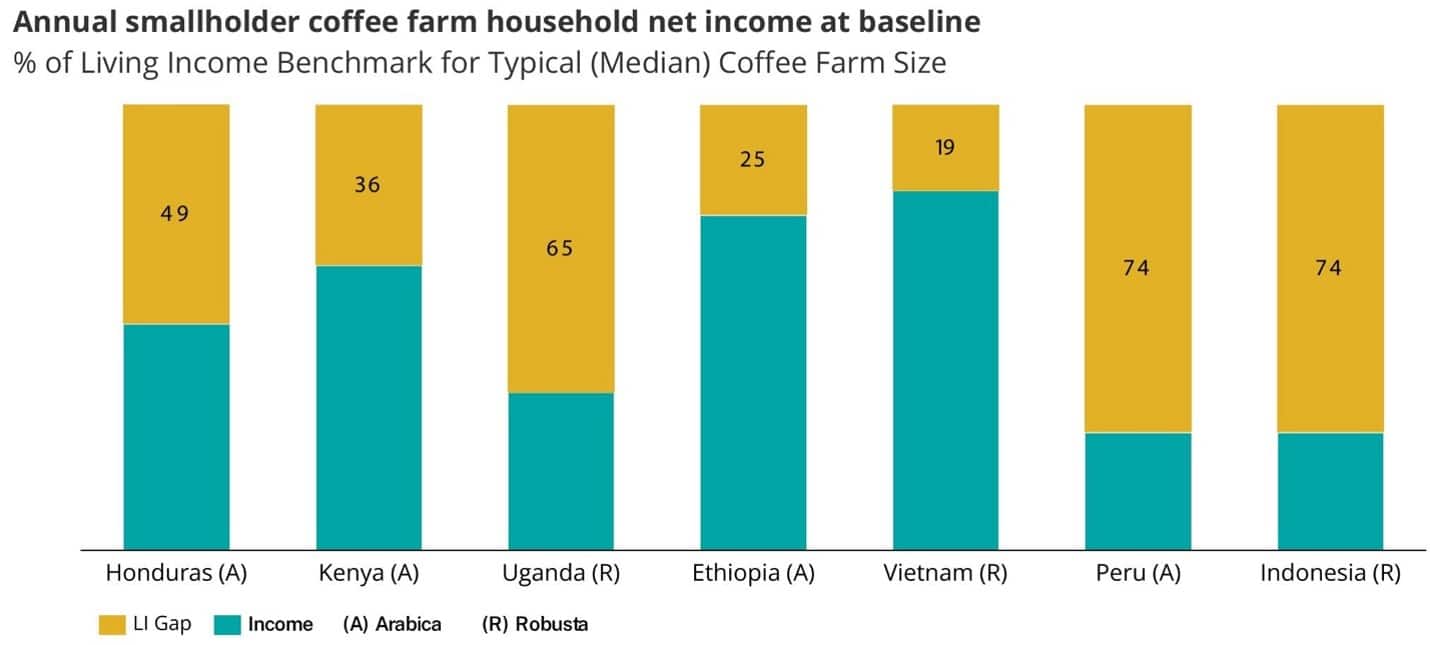
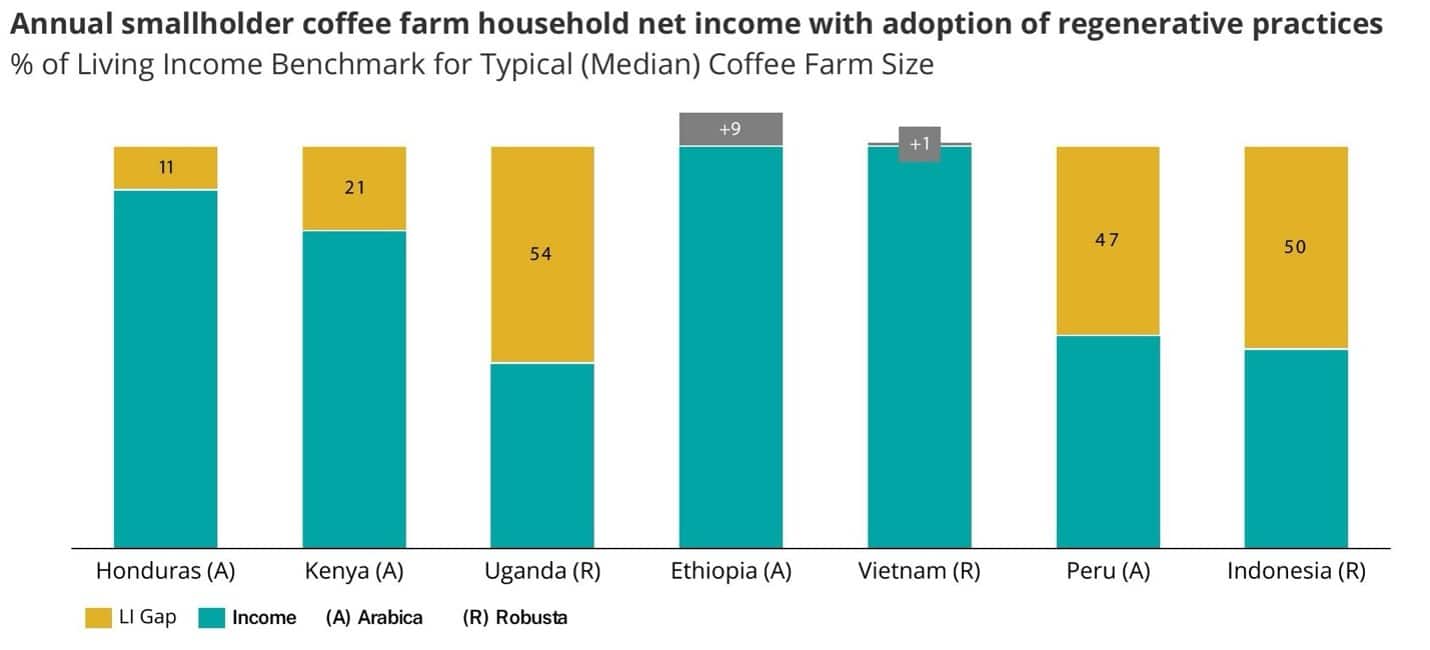
At baseline, before adopting regenerative practices, the typical coffee farming household in all seven countries does not earn a living income. Peru and Indonesia have the widest gaps, with households earning just 26 percent of the benchmark; Vietnam has the narrowest, at 81 percent. Regenerative practices change that picture substantially. The paper’s modeling shows that typical farmers in Ethiopia and Vietnam could reach a living income through practice adoption alone, and the gap narrows significantly in Honduras and Kenya. In Uganda, Peru, and Indonesia, practice adoption substantially improves income, but the typical households still only earn around half the benchmark, limited by small farm size or high production costs.
Procurement Practices Are Key
Coffee prices can undo or amplify the income gains from regenerative practice adoption (2023 was the baseline long-term average price used in the modeling). A 25 percent increase in farmgate prices would be enough for the typical Honduran farmer to earn a living income, and it would narrow the gaps in Kenya and Peru substantially. A 25 percent price decline, by contrast, largely erases the income gains from regenerative adoption.
Predictable revenue derived from stable prices and secured offtake volumes can be as important as the price itself, so that farmers have incremental income to invest over time and confidence in the return that the investments will provide. A company cannot control global market prices, but it can use procurement practices to help stabilize and increase farm gate price within a shifting market.
Resilience Is an Outcome and an Enabler
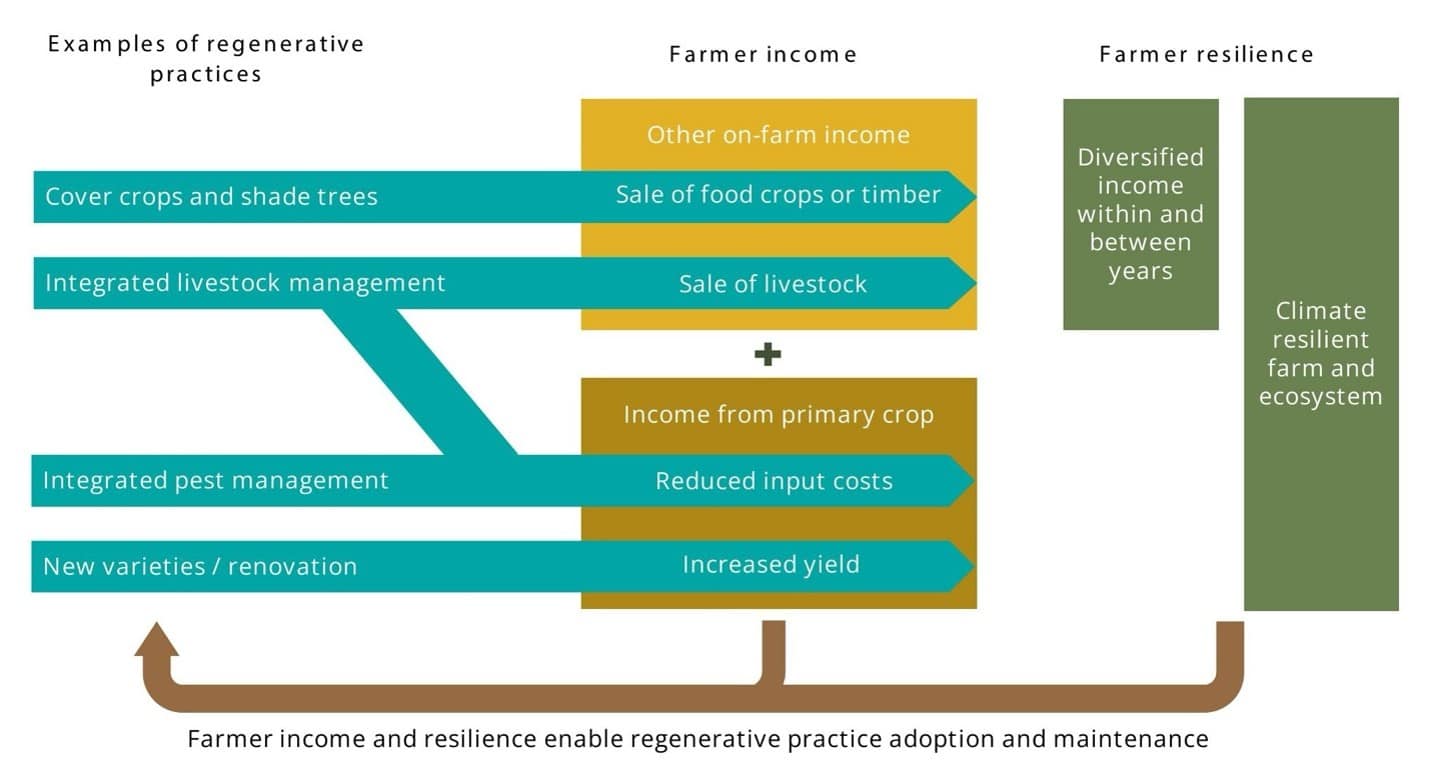
The graphic below illustrates the reinforcing relationship at the heart of Fostering Resilience: Regenerative Agriculture and Living Income. By diversifying on-farm income sources and improving the profitability of the primary crop, regenerative practices help farmers earn more stable, year-round income while strengthening the climate resilience of their farms and surrounding ecosystems. That added income and resilience, in turn, give households the means and the confidence to keep investing in the practices that produced them.
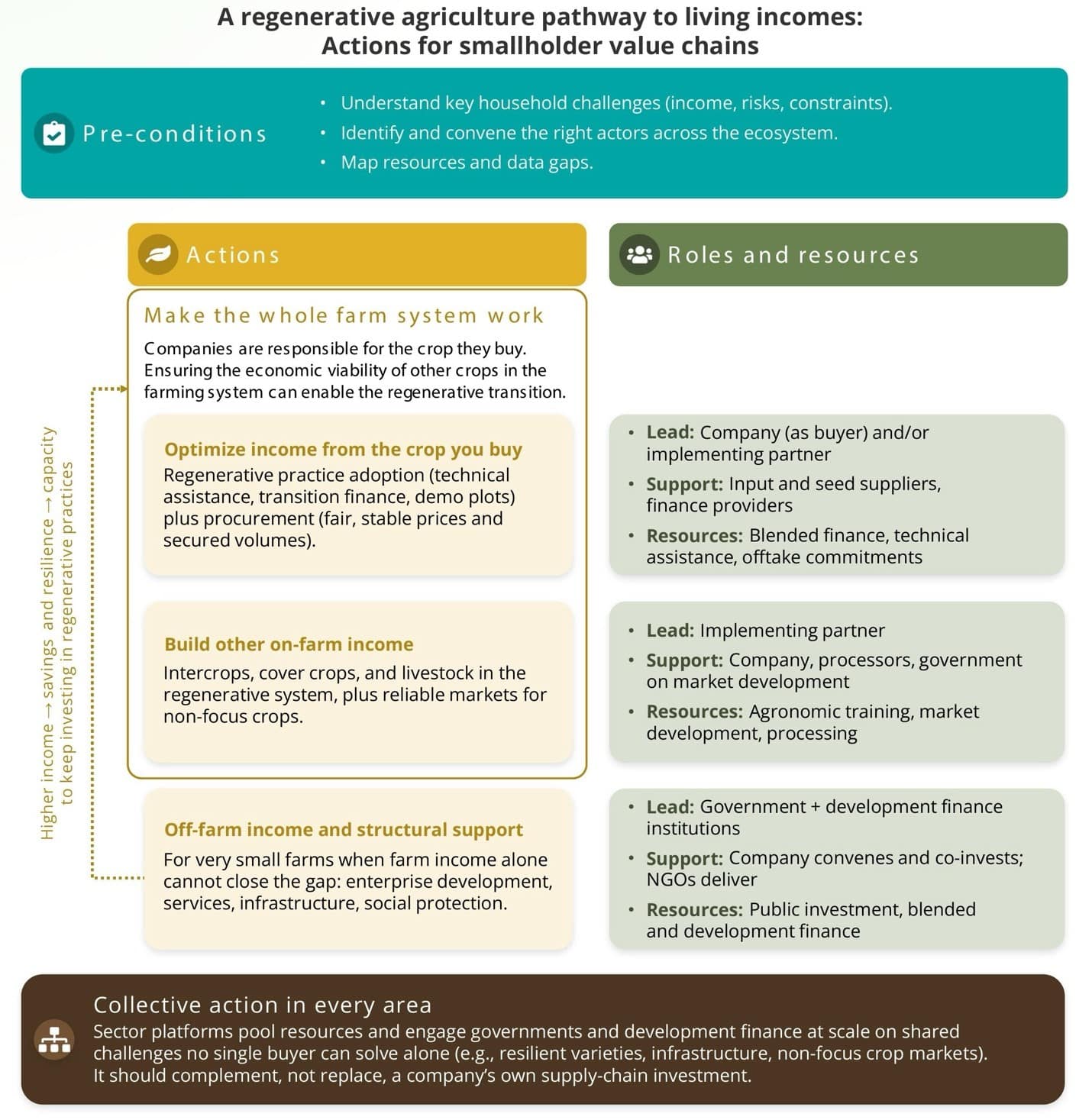
Regenerative agriculture will not close the living income gap by itself, and no single actor can close it alone. Fostering Resilience: Regenerative Agriculture and Living Income offers a pathway for stakeholders to advance regenerative agriculture and living incomes for smallholder farmers. The graphic below synthesizes the key pre-conditions, actions, roles, and resources discussed throughout the paper. Now, we need to move from modeling and frameworks to coordinated action and impact.