
What 15 years in clinical practice and two years in Haiti taught me about the cost of overlooking the human experience
I was 19 years old when I went to Haiti. I spent two years there doing service work, building physical structures, laying infrastructure, and spending a lot of time teaching people how to lead more accountable, productive lives with what they had in front of them. Not what they wished they had. What they had.
That experience drove me to pursue medical and business training, so I could carry those lessons into systems and communities that needed them. Everything I’ve built since traces back to what I learned on the ground in Haiti when I was barely an adult.
What I found in clinical practice, years later, was a version of the same drift I’d seen there. Not the same severity. But the same pattern.
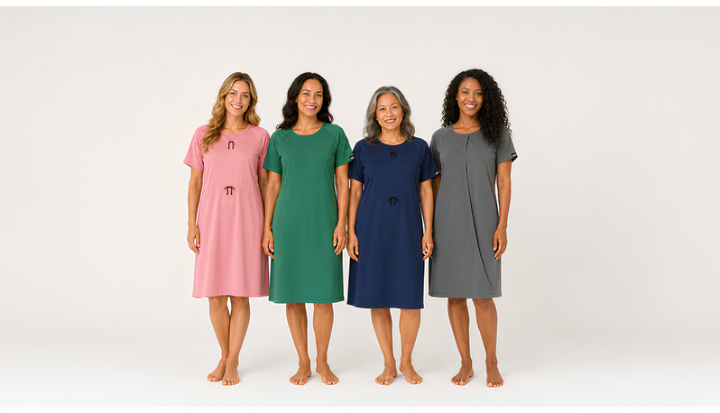
Every patient who walked into a treatment room, regardless of who they were or what they’d built, eventually ended up in the same thing: a patient gown that hadn’t meaningfully changed in over a century. A garment designed for access and efficiency, not for the person wearing it.
I watched people disappear into that gown. Not physically. But something shifted the moment they put it on. They stopped being a teacher, a parent, an athlete, a kid. They became a patient. And the system, with the best intentions in the world, reinforced that at every turn.
The cost of that isn’t abstract. I had a patient who avoided care for two years because the exposure, the loss of control, the sense that she had stopped mattering the moment she walked through the door. She finally came in. By then, she had lost her leg. For people in underserved communities who already have every reason to distrust the system, that gap between feeling dignified and feeling diminished is the difference between a manageable condition and a life-altering one. Between staying in the workforce and not. That’s a poverty story dressed up as a healthcare story.
Dignity isn’t soft. It’s measurable. Patients who feel respected and seen are more likely to follow through on treatment, stay with the same provider, and avoid the anxiety-driven complications that extend stays and inflate costs. Dignity is an operational lever. One most organizations have never touched.
So when I co-founded GIV Gowns, I wasn’t just building a product. I was making a business argument: that the organizations willing to invest in the full human experience of the people they serve will outperform those that don’t. Everything I’d seen in Haiti, in clinical practice, in building companies — it all pointed to the same place. When people feel like people, they behave differently. They show up. They engage. They trust.
That argument is being validated.
One of our Hero Collection patients was a boy managing a chronic illness. A lacrosse player. His teammates signed his custom gown, jersey number and all. His parents spent an hour arguing with him to get in the car for treatment. After he got his gown, he grabbed it himself and walked out the door. When we asked him how it felt, he said: “When I wear this gown, I don’t feel sick.”
That’s not just a good story. It’s a compliance story, a retention story, a family satisfaction story that ripples into every interaction that healthcare partner has with that family for the rest of their lives.
The same instinct drives the GIV Back Initiative. Every gown purchased automatically funds medical outreach — supplies, care, and dignity for underserved populations — alongside education, skills training, and economic opportunity for communities that need it most. It’s not a donation program bolted onto a business model. It’s the same work I was doing at 19 in Haiti, built into the transaction. You buy a gown. Someone who has historically had the least access and the least reason to trust care gets a little more of both.
The human experience is not an add-on. It is the product. When you design around it with the same rigor you apply to pricing, supply chain, or clinical function, you unlock value most organizations have been leaving on the table for a long time.
The patient gown was a 100-year problem hiding in plain sight. Accepted not because no one cared, but because no one had stopped long enough to ask whether it could be different.
That question is still the most powerful business tool I know. Not disruption for its own sake. Genuine curiosity about where human dignity has been designed out of an experience, and what it would mean to design it back in.
Whatever sector you’re working in, look for the patient gown in your own business. The touchpoint everyone accepts. The moment the person in front of you stops feeling like a person.
That’s not just a design problem. That’s the whole thing.